

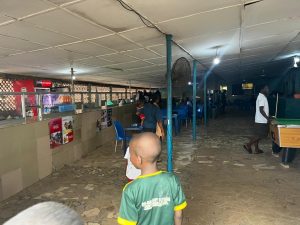
As lunchtime approaches at the Crescent University cafeteria, students gather to buy meals before returning to their lectures. However, for many students, buying food is no longer as simple as it used to be. Rising food prices and the increasing cost of living have forced many to change their eating habits, reduce the number of meals they eat, and depend more on provisions just to get through the week.
Students at the Crescent University cafeteria during lunchtime, as many adjust their spending and eating habits due to rising food prices.
For Inioluwa Ayodele, a 200-level student, buying food at the cafeteria remains a daily routine despite the rising prices. She said she buys food at least twice a day but has noticed that food portions have reduced while prices have increased by about ₦100 to ₦200.”I have had to cut down on other expenses so I can eat enough for the day,” she said. “I now rely more on provisions and even get my drinking water from a water distributor instead of buying sachet water.”Another student, Favour Okegbenro, shared a similar experience. Although she receives ₦25,000 weekly, she explained that it is no longer enough to cover her feeding expenses.”Meals that used to cost about ₦2,000 now cost between ₦2,500 and ₦3,000,” she said. “I spend between ₦5,000 and ₦6,000 daily on food, so I often have to ask for more money and rely on provisions.”For Tijani Zanib, the increase in food prices has changed both how often and how much she eats. She explained that she buys food from the cafeteria about five times a week but now eats only once a day and depends more on cereal and other provisions to supplement her meals.Similarly, Aaliyah Adebowale said the cost of living has become overwhelming. She buys food only once a day and has turned to cheaper meal options.”I rely more on swallow because it is cheaper at Blue Café, where they give enough soup. Later in the day, I make confirm eba using the remaining soup,” she explained.

The Crescent University Cafeteria, where students and food vendors are experiencing the effects of the rising cost of living.
The challenges are not limited to students alone. Adewunmi Taiwo, popularly known among students as “Auntie Taiwo,” a food seller at the Crescent University cafeteria, said the rising cost of ingredients has made running the business increasingly difficult.According to her, between January and March, a bag of pepper sold for about ₦9,000 to ₦10,000, but it now costs between ₦25,000 and ₦26,000. She added that the prices of cooking oil, eggs, and other ingredients have also increased significantly.Mrs. Taiwo explained that the constant rise in the prices of ingredients has greatly reduced the profit made from the business.”Whenever we go to the market, the prices increase again before our next purchase. After selling the food and calculating our expenses, it feels like we are only recovering the money we spent on ingredients, with little or no gain,” she said.Despite the increase in production costs, Mrs. Taiwo said they try not to raise food prices excessively because they understand that most students depend on allowances from their parents.”We are serving young adults who are mostly sponsored by their parents. We cannot just keep increasing prices because we know they have limited allowances,” she said.She also revealed that students’ eating habits have changed significantly.”People who used to buy food three times a day now buy food only once or twice. Many eat in the morning, look for something small to snack on during the afternoon, and wait until night before having another proper meal,” she said.Looking ahead, Mrs. Taiwo expressed hope that the government would take practical steps to reduce the cost of living. She noted that many families can no longer afford nutritious meals and encouraged young people to embrace agriculture as a way of improving food production and making food more affordable.The experiences shared by both students and Mrs. Taiwo highlight the reality of rising living costs on campus. While students continue to adjust their eating habits and spending, food vendors are also struggling with higher prices and shrinking profits. Until the economic situation improves, both groups will continue to make difficult choices in order to cope with the rising cost of living.
106 total views, 106 views today

