
Nigeria has made significant progress in reducing child mortality over the last three decades, but preventable deaths among newborns and children under five remain a major public health concern, according to data compiled from national and international health agencies.
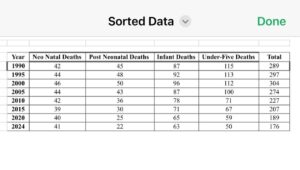
Figures drawn from the National Health and Household Survey (NHHS), the National Bureau of Statistics (NBS) and global child survival estimates published by the United Nations Inter-agency Group for Child Mortality Estimation (UN IGME) show that total child mortality declined from 289 in 1990 to 176 in 2024, representing an overall reduction of approximately 39 percent.
The UN IGME, which is led by UNICEF and includes the World Health Organization (WHO), the World Bank and the United Nations Population Division, compiles and harmonizes child mortality estimates used worldwide.
According to the latest reports from these organizations, Nigeria has recorded steady improvements in child survival, largely due to expanded immunization programmes, better maternal healthcare, and increased access to essential health services.
Figure 1: Child Infant Mortality Trends in Nigeria (1990–2024).
Source: NHHS, NBS, UN IGME, UNICEF, WHO and World Bank.
Source: Health and Household Survey (NHHS); National Bureau of Statistics (NBS); United Nations Inter-agency Group for Child Mortality Estimation (UN IGME); UNICEF; World Health Organization (WHO); World Bank.
Data Reveals Steady Progress:
An analysis of the dataset shows that post-neonatal deaths recorded the most significant decline, dropping from between 45 and 50 deaths during the 1990s to 22 deaths in 2024.
Infant mortality also decreased steadily from 96 deaths in 2000 to 63 deaths in 2024, while under-five mortality fell from 115 to 50 over the same period.
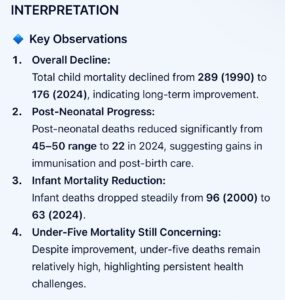
These trends suggest that sustained investments in vaccination, improved nutrition, disease prevention and child healthcare programmes are producing measurable results.
A Persistent Challenge:
Despite these gains, the data also highlights ongoing concerns.Neonatal deaths occurring within the first 28 days of life have remained relatively stable over the years, indicating that newborns continue to face serious risks during the earliest stage of life.
According to UNICEF and the World Health Organization, many of these deaths are linked to preventable causes, including complications during childbirth, premature birth, infections, inadequate maternal care and limited access to skilled healthcare workers, particularly in underserved communities.
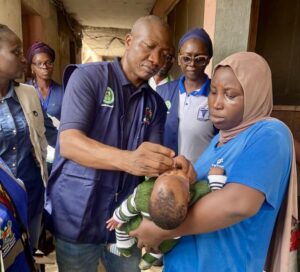
Behind Every Number Is a Family:
Statistics alone cannot capture the emotional weight of child mortality. Every figure in the report represents a child whose future was either protected through effective healthcare or lost to preventable circumstances. For many Nigerian families, access to quality healthcare can mean the difference between celebrating a child’s first birthday and mourning a life cut short.
While national indicators continue to improve, many communities still face barriers such as poverty, poor road networks, shortages of healthcare professionals and limited medical facilities.
The Way Forward:
Public health experts agree that continued investment is essential to sustain the progress already achieved.
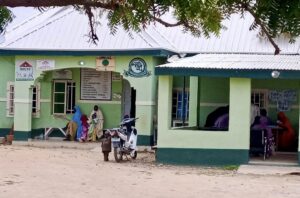
Expanding primary healthcare services, increasing routine immunization coverage, improving maternal healthcare, training more skilled birth attendants and strengthening healthcare infrastructure in rural communities are among the measures that could further reduce preventable child deaths.
Greater collaboration between government institutions, healthcare providers, development partners and local communities will also be critical to ensuring that every child has an equal chance of survival.
Conclusion:
Nigeria’s child mortality trend tells a story of hope, resilience and unfinished work.
The decline in mortality over the past three decades demonstrates that evidence-based health interventions save lives. However, until every child has access to quality healthcare regardless of where they are born, the work remains incomplete.
“Every statistic represents a child. Every improvement represents a life saved”.
277 total views, 5 views today